|  | Welcome to guidebook, a website dedicated to preserving and showcasing Graphical User Interfaces, as well as various materials related to them.
|  |
| |
| | Site last updated on 6th October 2006:
| |
| |
| | Check out exclusive posters commemorating various obsolete GUI elements and applications:
|  |  |
| |
| |
| | | By the second version of ArthurOS, Acorn decided to rename it RISC OS because of the movie “Arthur 2: On the rocks,” which just premiered in the cinemas. |
| |
| |
|
| | 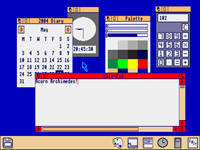 | Since in 1987 RISC OS was still not ready for prime time, and the new Acorn Archimedes machines were about to ship, ArthurOS was written as a temporary replacement. As you can imagine, it was pretty limited, but already introduced several concepts that survived in RISC OS for many years – for example the icon bar at the bottom of the screen (by many considered the inspiration for taskbar in Windows 95) and pop-up menus invoked by pressing the middle mouse button.
 |
| |
| |
| | 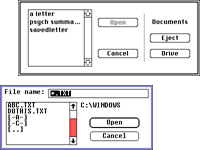 | File selector dialogs in both System 1 and Windows 1.0 looked and behaved very primitively. In time, with thousandfold increase of number of files available to the user, file opening dialogs evolved into bigger and way more complicated features.
 |
| |
| |
| | 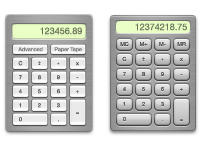 | The calculator icon changed slightly between Mac OS X 10.2 Jaguar and Mac OS X 10.3 Panther, to reflect the latter’s switch to even more metal. Is this the only change? Check for yourself in the big icon chart.
 |
| |
| |
|